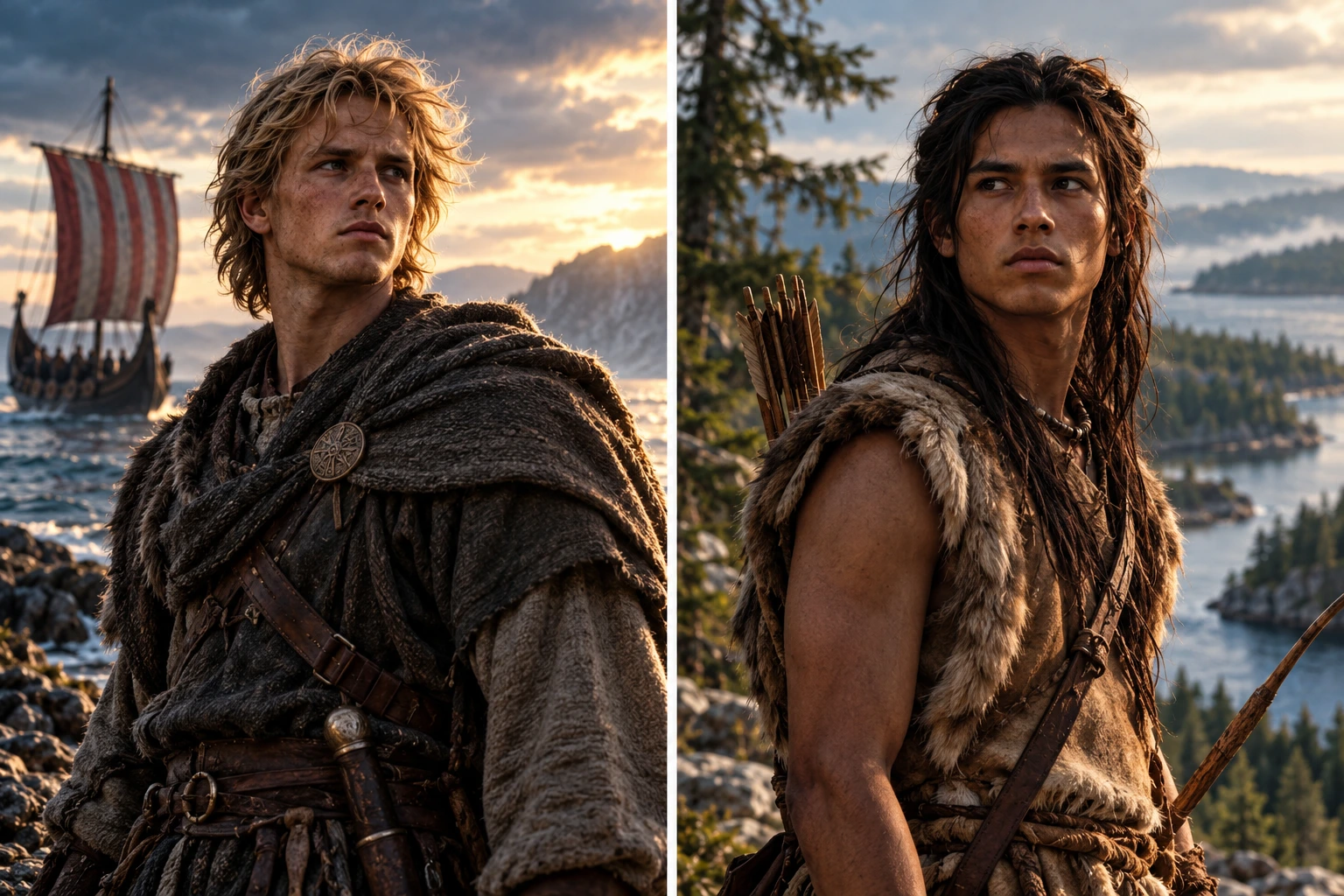
The voyage west
Einar Tryggvason
A young Norseman seeking his place in a world shaped by courage, loyalty, and reputation.
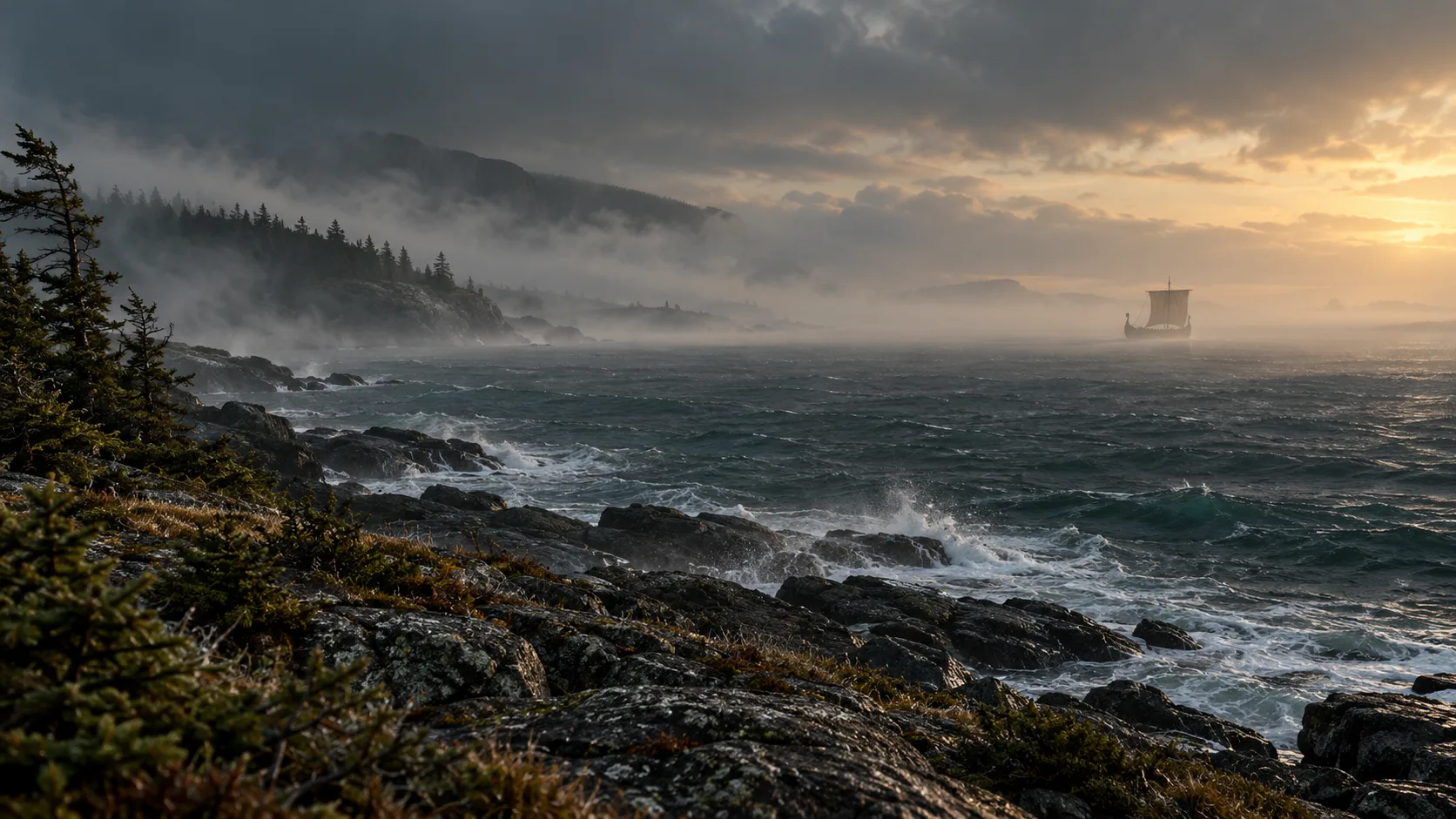
World of A’Viking West
A journey into the history, people, and places behind The First Shore.
The voyage west
The series title A’Viking West echoes “to go a-viking,” an English rendering of the Old Norse fara í víking, meaning to set out on a raiding voyage.
Norse movement across the North Atlantic unfolded over generations: from Scandinavia to Iceland, onward to Greenland, and around AD 1000 to the coastlines of North America.
In the novel, Einar travels aboard Blood Eagle, a fictional ship carrying him beyond the boundaries of the life he knows. The western shore is unfamiliar to the voyagers—but it is not an empty world. Peoples with established families, communities, knowledge, and histories are already there.
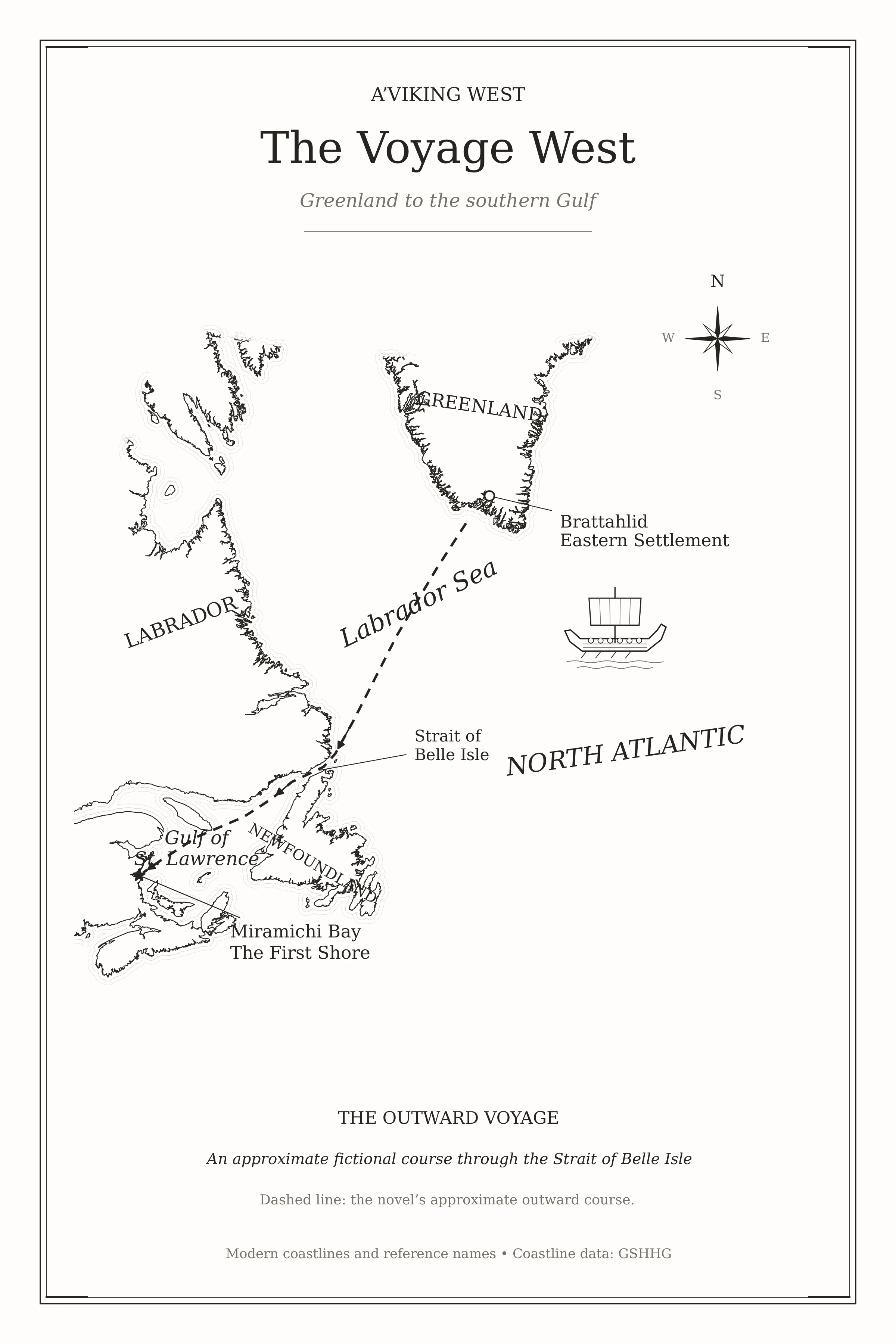
The route in the novel
The approved front-matter map places the fictional voyage within recognizable North Atlantic geography. Its dashed course belongs to the novel; the coastlines and place names provide modern orientation.
Blood Eagle and its route remain fictional. L’Anse aux Meadows is the confirmed archaeological site discussed later on this page, and the map does not claim that the novel’s Miramichi destination is historically documented.
Open high-resolution mapThe people of two worlds
The voyage west
A young Norseman seeking his place in a world shaped by courage, loyalty, and reputation.
The world already here
A young Indigenous man whose world, obligations, family, and ambitions exist independently of the arrival of Norse voyagers.
The expedition leader
An experienced voyager leading the westward expedition into waters known through report, memory, and hard-won seamanship.
Daughter of Erik the Red · Sister of Leif Eiriksson
Determined and ambitious, Freydis belongs to one of the defining families of the Norse Atlantic world—and will matter beyond this first voyage.
Commander of Blood Eagle
An experienced commander responsible for ship, crew, and the difficult choices demanded by an uncertain western passage.
A community with its own history
Parents, elders, children, hunters, makers, and knowledge keepers whose lives and obligations exist far beyond any encounter with outsiders.
The world around AD 1000
The novel draws from three different kinds of knowledge. Keeping them distinct matters: physical evidence can establish some events, written traditions preserve others, and fiction enters the spaces where the record cannot answer every human question.
Archaeology confirms Norse activity at L’Anse aux Meadows in Newfoundland. Timber cut with metal tools provides a secure calendar date of AD 1021 for activity at the site. This evidence does not establish a Norse landing in the Miramichi region.
Medieval Icelandic texts preserve accounts of Leif Eiriksson, Freydis Eiriksdottir, and voyages to Vinland. Told orally before they were written down, the sagas are essential literary sources—but they are not eyewitness archaeological records.
Einar, Actaudin, Blood Eagle, their relationships, and the novel’s particular encounters in the Miramichi region belong to the imaginative world of A’Viking West. They are shaped by research, not presented as documented events.
A necessary boundary: the novel does not claim archaeological proof of a Norse landing at its particular fictional location in the Miramichi region.
The first shore
The second front-matter map narrows the view to Miramichi Bay and its approaches. The coast and modern reference names orient the reader; the dashed encounter area and inlet belong to the novel.
Presenting that boundary on the map is deliberate. The region’s documented Indigenous history stands independently of the book’s imagined Norse arrival.
Open high-resolution map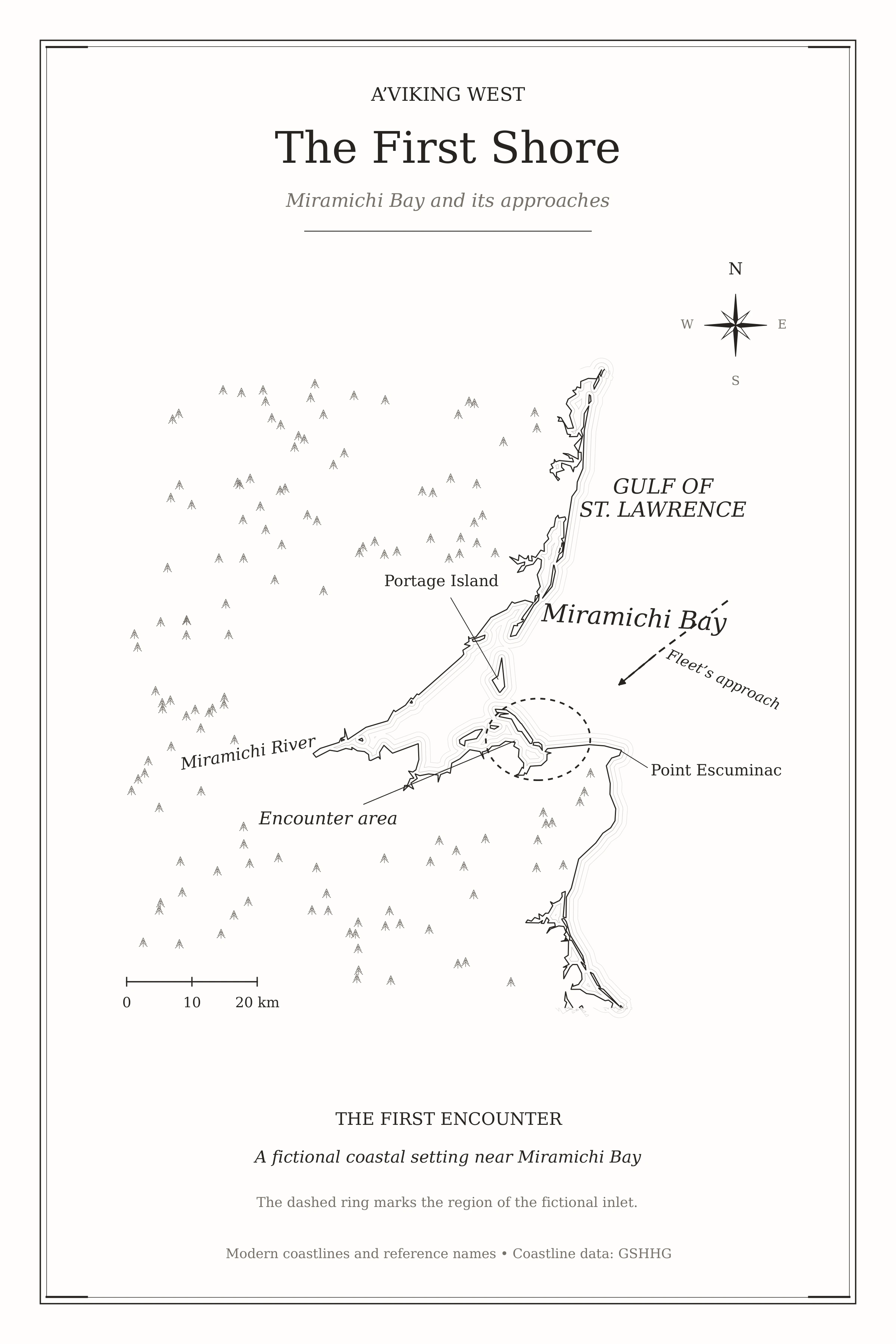
Behind the story
I began with a question that the familiar voyage story does not fully answer: what did an unfamiliar sail on the horizon mean to the people already living on that shore?
For the Norse voyagers, the western ocean held danger, possibility, and the chance to become someone new. For the people ashore, those same ships entered a world of existing families, obligations, ambitions, and knowledge. Neither perspective is complete without the other.
That tension opened the story I wanted to tell—one shaped by curiosity and misunderstanding, by competing loyalties, and by the courage required not only to face the unfamiliar, but to question what identity and belonging ask of us.
— Ted Malone
Historical notes & sources
Evidence for the period is meaningful but incomplete. Archaeology, community-held history, and medieval texts answer different questions. The novel’s reconstruction is an imaginative interpretation—not a claim that undocumented events have been proven.
Archaeology, site history, and interpretation of the only confirmed Norse site in what is now Canada.
Visit sourcePeer-reviewed research establishing AD 1021 as a secure date for Norse activity at L’Anse aux Meadows.
Visit sourceAn introduction to the Vinland traditions and the relationship between saga accounts and archaeological inquiry.
Visit sourceCommunity-led interpretation of more than 3,000 years of Mi’kmaq history on the Miramichi River.
Visit sourceA community profile describing Metepenagiag’s enduring relationship with the Miramichi River and more than 3,000 years of continuous settlement.
Visit source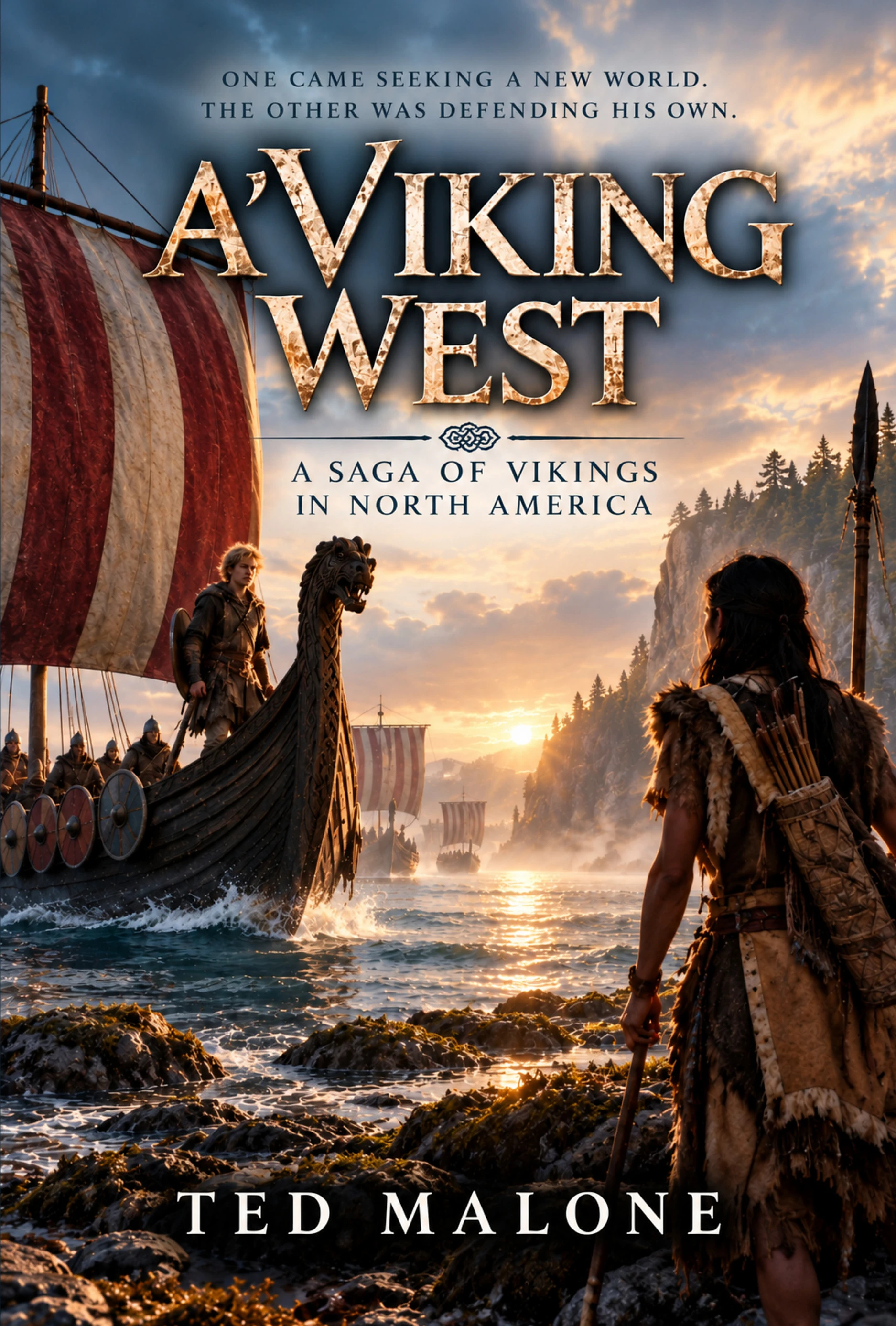
The journey begins
A’Viking West: The First Shore arrives November 11, 2026. Meet the people on both sides of the horizon.
Discover the Book